
Good grammar is sexy.
Editing Your First Draft: Watch Out for These 5 Grammatical Errors
Good grammar is sexy.
Good grammar is sexy.
Meeting lots of great new folks!

I’ve been struggling with a decision on one of my book projects that has pretty much had me blocked from writing on it for a while. The decision, related to point of view, needed to happen soon because continuing to write would require major revision later (and that’s just not the kind of tedious rewrite that has any fun to it at all). I decided to stop letting it drive me bats, set it aside completely, and take a few days vacation – from work, from the house, from writing – even from the puppies we decided to send off to DogVacay. I thought maybe if I just took a break, I’d be able to make the decision and move forward.
I hopped on the plane this afternoon, popped open my laptop to look at restaurants we might want to visit on our trip, and BAM. Wouldn’t you know it, as soon as I made the decision to stop making the decision, the answer was all of a sudden just… there. By the time the flight landed, I had written a couple pages of notes, supplemented my outline, flagged some re-write areas, and added POV detail to the character sketches.
How many times does this need to happen to me before I quit trying so hard?

The Notebook1. “The greatest thing you’ll ever learn is just to love, and be loved in return.” ~ Moulin Rouge 2. “When you realize you want to spend the rest of your life with somebody, you want the rest of your life to start as soon as possible.” ~ When Harry Met Sally 3. “To me, you are perfect”…
via The 30 Most Romantic Movie Quotes Of All Time — Thought Catalog
Emotional intelligence – by far the number one trait I look for when hiring employees.
Stop by Friday April 1st through Sunday April 3rd! Meet…greet..and leave your links! Every blogger is invited!
A couple times in grad school, we had quite serious conversations about swearing in our writing class. I don’t mean swearing in class – I mean swearing in our writing. It seemed we had stumbled upon a trend whereby writers appeared to use swear words to shock and awe so often that, much like the overuse of the exclamation point or bold font, they eradicated its effectiveness completely.
Writing, much like cooking, needs the right balance of flavors, and profanity is a powerful seasoning. A Psychology Today article from 2012 describes several good reasons for swearing. Many people I know would completely agree. However, using swear words comes at a cost. A 2015 Forbes article cites a CareerBuilder.com study that states 81% of employers surveyed believe swearing at work “brings an employee’s professionalism into question.” What does what you write say about you?
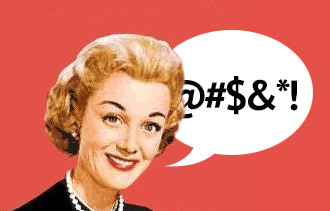
Having grown up in the North where swear words pretty much equated with punctuation, swearing didn’t bother me all that much at the time. I remember my first week on campus at the very Southern University of Tennessee attending a welcome reception to meet our professors. At one point during a circle of small talk, I casually dropped in an “F bomb,” which caused, I kid you not, a moment of complete silence before chatter resumed. Just like a scene in a movie.
It doesn’t take a genius to recognize a gaffe of that magnitude and I became acutely aware of a great many cultural differences. While, despite having spoken in what felt like the loudest voice ever used indoors in the history of man, I am sure no one remembers that moment–certainly not the way I do, I am very certain that a whole heap of perceptions occurred…whether the witnesses realized it consciously or not.They likely categorized me as one of “those Yankees” (bless her heart). It’s possible they questioned my intelligence, despite the competitiveness of the program, because fairly or unfairly, swearing is often considered a sign of questionable education and upbringing.
Now don’t think for a minute that Southerners don’t swear. They do. Oh yes ma’am and/or sir, they do. But instead of using words as punctuation, like a Northerner, they choose exactly the right word at exactly the right moment for effect. Should the timing be off or the setting wrong, as in my faux pas, the words are met with the slight downward cast and almost imperceptible disappointed shake of the head. Used properly, the word crafts paragraphs worth of meaning and shared understanding. Swearing for style. The key to the effect is to use the words ever so sparingly. And rather than string several together, Southerners simply stretch a single syllable word into two, sometimes adding a leading word, as if they’re setting up a tee. For example, “shit” might become “well, shee-ut.”
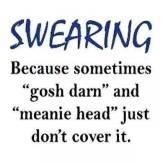 Back to writing. Does it make sense to use swear words in writing? My opinion is Yes! and NO! I think there is a right (stylish) way to do it and a wrong (people gonna think you’re kinda dumb) way to do it.**
I’ve seen profanity used very well. If one of your characters swears regularly, it can become part of the persona. If none of your characters swear regularly, but one drops just the right word in the perfect moment, you’ve painted the most wonderful dramatic picture. However, I’ve also seen profanity go horribly wrong. If every character swears all the time, not only is it unrealistic, the reader can’t easily tell the characters apart.
Interested in reading some more? Here are a couple resources for profanity in writing:
[**editorial note: if you’re constantly swearing on Facebook or other social media, newsflash: YOU’RE IN PUBLIC. The room is silent and everyone is staring at you. Your readers are judging you without mercy and you’re proving them right. You come off as an unkempt, uncouth moron with an extremely limited vocabulary, so just stop now.]

“If there is magic in story writing, and I am convinced there is, no one has ever been able to reduce it to a recipe that can be passed from one person to another. The formula seems to lie solely in the aching urge of the writer to convey something he feels important to the […]
via John Steinbeck: Magic in Story Writing. (A Quote) — ronovanwrites
My second grade teacher, Mrs. Tucker, passed away recently. Everyone adored her, myself included. Like other losses suffered by the close-knit community in which I grew up, her passing sparked a series of nostalgic Facebook posts and animated phone calls of remembrance. I hadn’t really pinpointed before, but I realized talking through memories that Mrs. Tucker was the first adult who encouraged me to become a writer.
That was one of the years I missed a lot of school. The blizzard of ’78 took everyone out for a while, but the chicken pox followed up with a bad upper respiratory infection stretched my absence to nearly a month. One of my make-up assignments from Mrs. Tucker, an “essay” on how the blizzard affected us, only needed to be a paragraph or so – typical of what one might expect from 7 year olds. Bored as I was from being home and confined to my room much of the time, I wrote a series of little stories. I wish I had them now. I remember one was about my mom’s cousin delivering groceries on a snowmobile and having to transfer them through my brother’s (2nd floor) bedroom window, which actually happened. Another one involved hooking up the neighbor’s dogs to a sled and assisting in a search and rescue, which happened only in my imagination.
 On the day I finally returned to school, Mrs. Tucker asked me to stay at her desk as the other kids left for lunch. I can’t recall exactly what she told me, but I do remember a funky warm sensation of bashful mixing with pride as she walked through my stories and pointed out things she felt were especially well done. I don’t believe she ever came right out and said ‘you should become writer’ or anything like that; rather, I think the time she took and the attention she gave encouraged me produced a much larger spark.
She had done something similar with reading, too – convincing me to take on my first chapter book earlier that school year (Charlotte’s Web) by telling me the ages on the shelves in the school library were simply ridiculous and I shouldn’t pay them any attention at all. That I do remember word-for-word because ‘simply ridiculous’ became my go-to phrase for quite some time.
Teachers, especially elementary school teachers, tend to be such lovely, wonderful people. It takes a special heart to be one and take on the responsibility of someone so very important in the lives of children. Mrs. Tucker, especially. Such a nice, nice lady.

Nice resource!
The other night I got an interesting insight into my novel. Apparently, in descriptive passages, there’s much about what people look like, what they wear, how they appear to one another, and not much about what they eat.
View original post 1,647 more words

 Erika for President
You must be logged in to post a comment.